

Viral contractile tail ejection system (kw:KW-1242)
The long and contractile tail of Myo-type virus acts as a molecular machine that ejects the viral DNA from the capsid into the host cell cytoplasm. The ejection system consists of a baseplate, a central tube and an external contractile sheath  .
.
Upon binding to the host cell surface, the baseplate changes its conformation and triggers sheath contraction, driving the rigid internal tail tube through the cell envelope.
The source of the forces that drive viral genome ejection is probably in part due to osmotic pressure imbalance between the virus inside and the host cytoplasm
.
Gram(-) hosts:
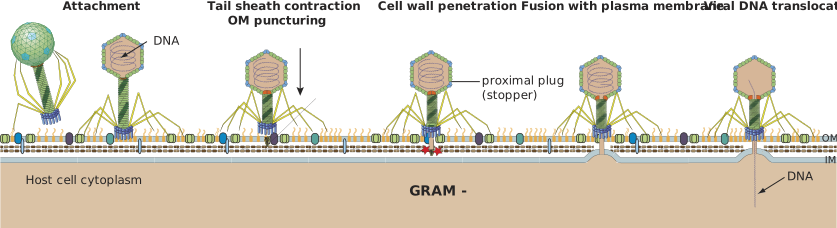
- Attachment to a host cell outer membrane (OM) receptor.
- Tail sheath contraction. Ejection of the internal rigid tube through the OM using the puncturing device.
- Virion-associated exolysin (if present) hydrolyzes the peptidoglycan layer. Ejection of the internal rigid tube through the cell wall.
- Complete contraction and ejection of the internal rigid tube. Fusion with the inner membrane.
- Viral DNA translocation into host cytoplasm.
Gram(+) hosts:
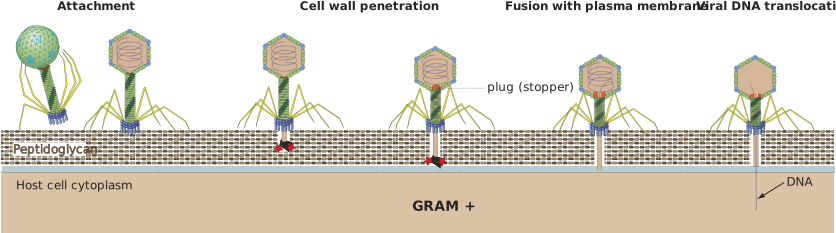
- Attachment to a host cell wall receptor.
- Tail sheath contraction. Virion-associated exolysin (if present) hydrolyzes the peptidoglycan layer. Ejection of the internal rigid tube through the cell wall.
- Complete contraction and ejection of the internal rigid tube. Possible ejection of the tape-measure protein and opening of the proximal plug. Fusion with the plasma membrane.
- Viral DNA translocation into host cytoplasm.
Petr G Leiman, Mikhail M Shneider
Adv. Exp. Med. Biol. 2012; 726: 93-114
Bo Hu, William Margolin, Ian J. Molineux, Jun Liu
Proc. Natl. Acad. Sci. U.S.A. September 1, 2015; 112: E4919-4928
Ian J. Molineux, Debabrata Panja
Nat. Rev. Microbiol. March 2013; 11: 194-204
Matching UniProtKB/Swiss-Prot entries
(all links/actions below point to uniprot.org website)31 entries grouped by strain
5 entries
Escherichia phage Mu (Bacteriophage Mu) reference strain
3 entries
Enterobacteria phage T4 (Bacteriophage T4) reference strain
3 entries
Escherichia phage P2 (Bacteriophage P2) reference strain
2 entries
Bacillus phage SP01 (Bacteriophage SP01) reference strain
2 entries
Clostridium phage phiCD119 (strain Clostridium difficile/United States/Govind/2006) (Bacteriophage phiCD119) reference strain
2 entries
Salmonella phage ViI reference strain
2 entries
Staphylococcus phage Twort (strain DSM 17442 / HER 48) (Bacteriophage Twort) reference strain
2 entries
Vibrio phage KVP40 (isolate Vibrio parahaemolyticus/Japan/Matsuzaki/1991) (KVP40) (Bacteriophage KVP40) reference strain
1 entry
Burkholderia phage BcepMu (isolate -/United States/Summer/2002) (Bacteriophage BcepMu) reference strain
1 entry
Enterococcus phage phiEF24C (Enterococcus bacteriophage phi-EF24C) reference strain
1 entry
Haemophilus phage HP1 (strain HP1c1) (Bacteriophage HP1) reference strain
1 entry
Halomonas phage phiHAP-1 (isolate -/Gulf of Mexico/-/2001) (Bacteriophage phiHAP-1) reference strain
1 entry
Mycobacterium phage Bxz1 (Mycobacteriophage Bxz1) reference strain
2 entries
Serratia phage KSP20 (Serratia marcescens bacteriophage KSP20)
1 entry
Enterobacteria phage T6 (Bacteriophage T6)
1 entry
Serratia phage KSP90 (Serratia marcescens bacteriophage KSP90)
1 entry