

Circovirus (taxid:39725)
VIRION
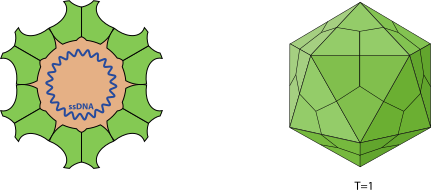
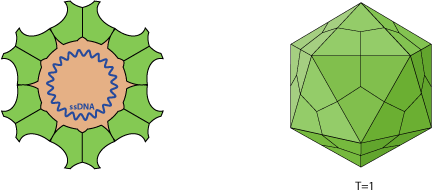
Non-enveloped, round, T=1 icosahedral symmetry, about 17 nm in diameter. The capsid consists of 12 pentagonal trumpet-shaped pentamers.

GENOME
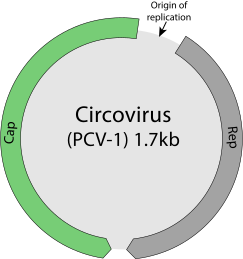
Monopartite, circular, ssDNA genome of about 1800 to 2000bp.
The genome is replicated through double-stranded intermediates. The replication (Rep) protein initiates and terminates rolling circle replication, the host DNA polymerase being used for DNA replication itself. There is a potential stem-loop structure in the intergenic region that includes a conserved nonanucleotide sequence (AGTATTAC) where ssDNA synthesis is initiated.
GENE EXPRESSION
The encapsidated viral DNA and the complementary DNA of the replicative intermediate encode two mRNAs for the Rep and capsid proteins.
Rep mRNA can undergo alternative splicing in some strains to produce Rep' protein.
ENZYMES
REPLICATION
NUCLEAR
- Virus penetrates into the host cell probably by clathrin- and caveolae-independent endocytosis.
- Uncoating, the viral ssDNA genome penetrates into the nucleus.
- Viral ssDNA is converted into dsDNA with the participation of cellular factors. dsDNA transcription gives rise to viral mRNAs.
- Viral mRNAs are translated to produce viral proteins.
- Replication may be mediated by a Rep protein, and would occur by rolling circle producing ssDNA genomes.
- These newly synthesized ssDNA can either
a) be converted to dsDNA and serve as a template for transcription/replication
b) be encapsidated by capsid protein and form virions released by cell lysis.
Host-virus interaction
Autophagy modulation
Cap protein of PCV2 induces activation of host autophagy in order to enhance its own replication
 .
.
Apoptosis modulation
PCV2 ORF3-encoded protein induces apoptosis by activating caspase-8 and caspase-3 pathways
. This protein may be a candidate for PML bodies inhibition which is essential for nuclear virus replication in mammals.
Matching UniProtKB/Swiss-Prot entries
(all links/actions below point to uniprot.org website)25 entries grouped by strain
5 entries
Pigeon circovirus (PiCV) (Columbid circovirus) reference strain
4 entries
Goose circovirus (GoCV) reference strain
2 entries
Canary circovirus (CaCV) reference strain
2 entries
Porcine circovirus 1 (PCV1) reference strain
7 entries
Beak and feather disease virus (BFDV)
5 entries
Porcine circovirus 2 (PCV2)
Acartia tonsa copepod circovirus taxid:1168547
| Protein | ModelArchive |
| Replication-associated protein (ATP-dependent helicase Rep) (RepP) | ma-jd-viral-20901 |
| Uncharacterized protein | ma-jd-viral-49947 |
Anguilla anguilla circovirus taxid:1420600
| Protein | ModelArchive |
| Putative capsid protein | ma-jd-viral-63316 |
| Replication-associated protein (ATP-dependent helicase Rep) (RepP) | ma-jd-viral-20702 |
Barbel circovirus taxid:759938
| Protein | ModelArchive |
| Putative capsid protein | ma-jd-viral-27842 |
| Replication-associated protein (ATP-dependent helicase Rep) (RepP) | ma-jd-viral-20903 |
Canary circovirus taxid:142661
| Protein | ModelArchive |
| Probable capsid protein | ma-jd-viral-28754 |
| Replication-associated protein (EC 2.7.7.-) (EC 3.1.21.-) (EC 3.6.1.-) (ATP-dependent helicase Rep)... | ma-jd-viral-20927 |
Canine circovirus taxid:1194757
| Protein | ModelArchive |
| Putative capsid protein | ma-jd-viral-27432 |
| Replication-associated protein (ATP-dependent helicase Rep) (RepP) | ma-jd-viral-20747 |
Duck circovirus taxid:324685
Finch circovirus taxid:400122
| Protein | ModelArchive |
| Capsid protein | ma-jd-viral-28761 |
| Replication-associated protein (ATP-dependent helicase Rep) (RepP) | ma-jd-viral-20866 |
| Uncharacterized protein | ma-jd-viral-58828 |
Goose circovirus taxid:146032
Gull circovirus taxid:400121
| Protein | ModelArchive |
| Capsid protein | ma-jd-viral-28760 |
| Replication-associated protein (ATP-dependent helicase Rep) (RepP) | ma-jd-viral-20763 |
| Uncharacterized protein | ma-jd-viral-29081 |
Labidocera aestiva circovirus taxid:1173709
| Protein | ModelArchive |
| Putative structural protein | ma-jd-viral-43922 |
| Putative viral replication protein | ma-jd-viral-20727 |
Mink circovirus taxid:1475143
| Protein | ModelArchive |
| Cap protein (Capsid protein) | ma-jd-viral-27514 |
| Replication-associated protein (ATP-dependent helicase Rep) (RepP) | ma-jd-viral-20734 |
Penaeus monodon circovirus VN11 taxid:1419711
| Protein | ModelArchive |
| Nonstructural protein 2 | ma-jd-viral-33106 |
| Replication-associated protein | ma-jd-viral-20894 |
| Structural protein VP | ma-jd-viral-28530 |
Pigeon circovirus taxid:126070
Porcine circovirus 3 taxid:1868221
| Protein | ModelArchive |
| Cap | ma-jd-viral-27790 |
| Cap (Capsid) | ma-jd-viral-27790 |
Porcine circovirus type 1/2a taxid:720569
| Protein | ModelArchive |
| Capsid | ma-jd-viral-27508 |
| Replication-associated protein (ATP-dependent helicase Rep) (RepP) | ma-jd-viral-20701 |
Raven circovirus taxid:345250
| Protein | ModelArchive |
| Capsid protein | ma-jd-viral-28759 |
| Replication-associated protein (ATP-dependent helicase Rep) (RepP) | ma-jd-viral-20758 |
Starling circovirus taxid:349370
| Protein | ModelArchive |
| Putative capsid protein | ma-jd-viral-28753 |
| Replication-associated protein (ATP-dependent helicase Rep) (RepP) | ma-jd-viral-20809 |
| Uncharacterized protein | ma-jd-viral-39523 |
Swan circovirus taxid:459957
| Protein | ModelArchive |
| Putative capsid protein | ma-jd-viral-28850 |
| Replication-associated protein (ATP-dependent helicase Rep) (RepP) | ma-jd-viral-20771 |
Zebra finch circovirus taxid:1642515
| Protein | ModelArchive |
| Capsid protein | ma-jd-viral-28756 |
| ORFC2 | ma-jd-viral-29717 |
| ORFV2 | ma-jd-viral-42535 |
| Replication-associated protein (ATP-dependent helicase Rep) (RepP) | ma-jd-viral-20778 |