

Sapovirus (taxid:95341)
VIRION
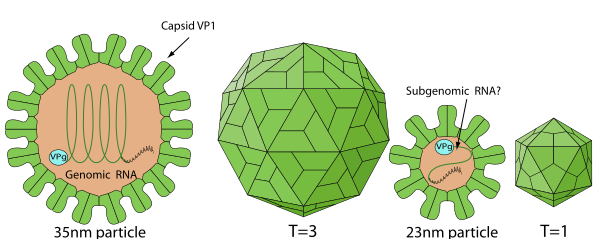
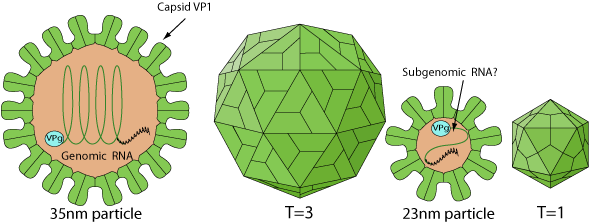
Non-enveloped, capsid of about 27-40 nm in diameter, with T=3 icosahedral symmetry. The capsid is composed of 180 capsid proteins.

GENOME
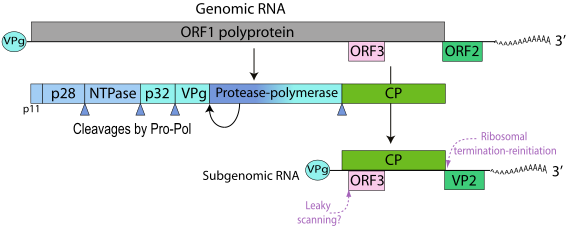
Monopartite, linear ssRNA(+) genome of 7.3 to 8.3 kb. The 5'-terminus is linked to a VPg protein and the 3'-terminus has a poly(A) tract.
GENE EXPRESSION
The virion RNA is infectious and serves as both the genome and viral messenger RNA. Cleavage of ORF1 polyprotein by the virus-encoded 3C-like cysteine proteinase yields the mature nonstructural proteins and the capsid protein. ORF2 encodes a small structural protein VP2 which is expressed through RNA termination-reinitiation.
ENZYMES
- RNA-dependent RNA polymerase [Protease-Pol Q672I1]
- VPG-type capping [VPg Q672I1]
- NTPase-helicase [NTPase Q672I1]
- Protease (Peptidase C24) [Protease-Pol Q672I1]
- Protease (Peptidase C37) [p32 Q672I1]
REPLICATION
CYTOPLASMIC
- Attachement to host receptors mediates endocytosis of the virus into the host cell.
- Uncoating, and release of the viral genomic RNA into the cytoplasm.
- VPg is removed from the viral RNA, which is then translated into a processed ORF1 polyprotein to yield the replication proteins.
- Replication occurs in viral factories. A dsRNA genome is synthesized from the genomic ssRNA(+).
- The dsRNA genome is transcribed/replicated thereby providing viral mRNAs/new ssRNA(+) genomes.
- Subgenomic RNA translation gives rise to the capsid protein and VP2.
- Assembly of new virus particles and release by cell lysis.
Matching UniProtKB/Swiss-Prot entries
(all links/actions below point to uniprot.org website)10 entries grouped by strain
3 entries
Sapporo virus (isolate GI/Human/Germany/pJG-Sap01) (Hu/Dresden/pJG-Sap01/DE) reference strain
3 entries
Sapporo virus (strain Human/United Kingdom/Manchester/1993) (Hu/SV/Man/1993/UK) reference strain
2 entries
Porcine enteric sapovirus (isolate Swine/United States/Cowden/1980) (Sw/SV/Cowden/1980/US) reference strain
2 entries
Sapporo virus (isolate GII/Human/Thailand/Mc10/2000) (Hu/SaV/Mc10/2000/Thailand)
Bat sapovirus TLC58/HK taxid:1185359
| Protein | ModelArchive |
| VP2 | ma-jd-viral-58991 |
Sapovirus (strain GII/Human/Japan/Sakai C12/2001) taxid:290314
| Protein | ModelArchive |
| ORF2 protein | ma-jd-viral-40101 |