

Erythroparvovirus (taxid:40121)
VIRION
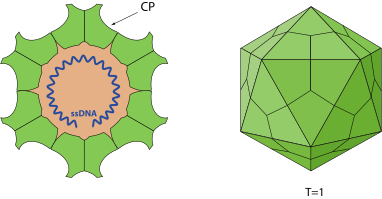
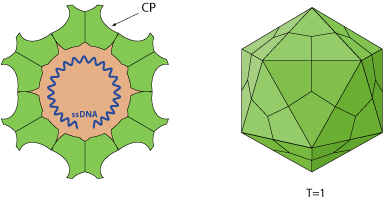
Non-enveloped, round, T=1 icosahedral symmetry, 18-26 nm in diameter. The capsid consists of 60 copies of CP protein.

GENOME
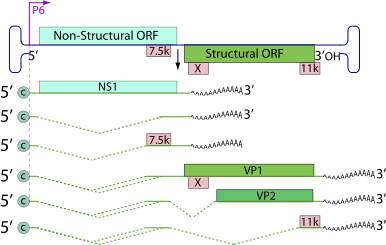
Linear, ssDNA genome of about 4 to 6 kb in size. Equal amount of positive and negative strands are encapsidated, although the percentage of particles encapsidating the positive strand can be lower depending on the host cell. ORFs for both the structural and non-structural proteins are located on the same DNA strand.
The genome is replicated through rolling-hairpin mechanism.
GENE EXPRESSION
Host proteins transcribe the genomes into mRNAs. Alternative splicing allows expression of both structural and non-structural proteins.
ENZYMES
REPLICATION
NUCLEAR
- Attachement to host receptors initiates clathrin-mediated endocytosis of the virion into the host cell.
- The virion penetrates into the cytoplasm via permeabilization of host endosomal membrane.
- Microtubular transport of the virion toward the nucleus.
- The viral ssDNA genome penetrates into the nucleus.
- The ssDNA is converted into dsDNA by cellular proteins.
- dsDNA transcription gives rise to viral mRNAs when host cell enters S phase and translated to produce viral proteins.
- Replication occurs through rolling-hairpin mechanism, with NS1 endonuclease binding covalently to the 5' genomic end.
- Individual ssDNA genomes are excised from replication concatemers by a process called junction resolution.
- These newly synthesized ssDNA can either
a) be converted to dsDNA and serve as a template for transcription/replication
b) be encapsidated to form new virions that are released by cell lysis.
Host-virus interaction
Apoptosis modulation
Parvoviruses infection induces host cell death, which is often directly associated with disease outcomes. B19V NS1 and 11kDa proteins induce apoptosis
via the activation of caspases
 .
.
Cell-cycle modulation
B19V also induces G2/M checkpoint arrest
.
Matching UniProtKB/Swiss-Prot entries
(all links/actions below point to uniprot.org website)7 entries grouped by strain
5 entries
Human parvovirus B19 (strain HV) (HPV B19) reference strain
2 entries
Human parvovirus B19 (isolate AU) (HPV B19)
Human erythrovirus V9 taxid:72197
Human parvovirus B19 taxid:10798
Human parvovirus B19 (isolate AU) taxid:648238
| Protein | ModelArchive |
| X protein | ma-jd-viral-48977 |
Human parvovirus B19 (strain HV) taxid:648237
| Protein | ModelArchive |
| Minor capsid protein VP1 (EC 3.1.1.4) (Coat protein VP1) | ma-jd-viral-41349 |