

Phlebovirus (taxid:11584)

VIRION
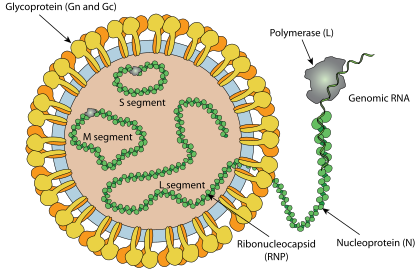
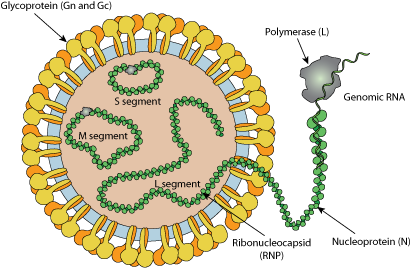
Enveloped, spherical. Diameter from 80 to 120nm. Glycoproteins at the surface of the envelope are arranged on an icosahedral lattice, with T=12 symmetry.
GENOME
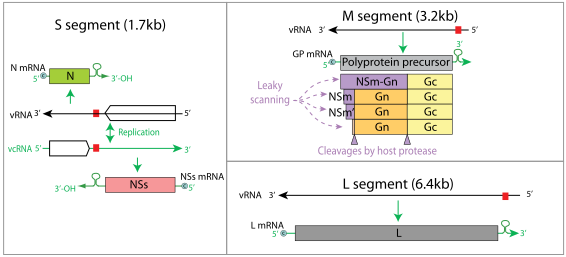
Segmented Negative-stranded RNA linear genome, L segment is about 6.4kb, M segment about 3.2kb and S segment about 1.7kb.
Encodes for six proteins.
GENE EXPRESSION
Transcription starts by viral RNA dependent RNA polymerase (L) binding to a promoter on each encapsidated segment, and is terminated by a strong hairpin sequence at the end of each gene. These are capped by L protein during synthesis using cap snatching , but are not polyadenylated.
S segment uses ambisense strategy to encode for several proteins: both genomic and antigenomic RNA are transcribed. The hairpin sequence is a stop polymerase signal which prevents ambisense transcription from producing dsRNA. M segment encodes for several polyproteins by leaky scanning, which are cleaved by host protease into Nsm-GN, Nsm, NSm',Gn and Gc proteins.
ENZYMES
REPLICATION
CYTOPLASMIC
- Virus attaches to host receptors though Gn-Gc glycoprotein dimer, and is endocytosed into vesicles in the host cell.
- Fusion of virus membrane with the vesicle membrane; ribonucleocapsid segments are released in the cytoplasm.
- Transcription, viral mRNAs are capped in the cytoplasm.
- Replication presumably starts when enough nucleoprotein is present to encapsidate neo-synthetized antigenomes and genomes.
- The ribonucleocapsids buds at Golgi apparatus, releasing the virion by exocytosis.
Host-virus interaction
Inhibition of host transcription initiation
The Rift valley fever virus NSs protein instead plays a role in the inhibition of the host transcription initiation by acting on host TFIIH.
Matching UniProtKB/Swiss-Prot entries
(all links/actions below point to uniprot.org website)15 entries grouped by strain
4 entries
Rift valley fever virus (strain ZH-548 M12) (RVFV) reference strain
3 entries
Toscana virus (Tos) reference strain
3 entries
Punta toro phlebovirus
3 entries
Rift valley fever virus (RVFV)
2 entries
Sandfly fever sicilian virus (SFS)
Adana virus taxid:1611877
| Protein | ModelArchive |
| Envelopment polyprotein (M polyprotein) | ma-jd-viral-61252 |
| Nonstructural protein | ma-jd-viral-25090 |
| Nucleoprotein | ma-jd-viral-17413 |
Aguacate virus taxid:1006583
| Protein | ModelArchive |
| Envelopment polyprotein (M polyprotein) | ma-jd-viral-61239 |
| Nonstructural protein | ma-jd-viral-25114 |
| Nucleoprotein | ma-jd-viral-17406 |
Chandiru virus taxid:629725
| Protein | ModelArchive |
| Nonstructural protein | ma-jd-viral-25084 |
| Nucleoprotein | ma-jd-viral-17405 |
Rift valley fever virus taxid:11588
Rift valley fever virus (strain ZH-548 M12) taxid:11589
| Protein | ModelArchive |
| Non-structural protein NS-S | ma-jd-viral-25083 |
| Non-structural protein S (NSs) | ma-jd-viral-25083 |
| Nucleoprotein | ma-jd-viral-17430 |
Sandfly fever Naples virus taxid:206160
| Protein | ModelArchive |
| Nucleoprotein (Nucleocapsid protein) | ma-jd-viral-17426 |
sandfly fever Turkey virus taxid:688699
| Protein | ModelArchive |
| Non-structural protein NS-S | ma-jd-viral-25101 |
| Nucleoprotein | ma-jd-viral-17420 |