

Bymovirus (taxid:39731)
VIRION


Non-enveloped, flexuous, filamentous, of two lengths (500-600 and 200-300 nm) x 12-15 nm in diameter. Symmetry helical. Presence of characteristic inclusion bodies within infected plant cells.
GENOME
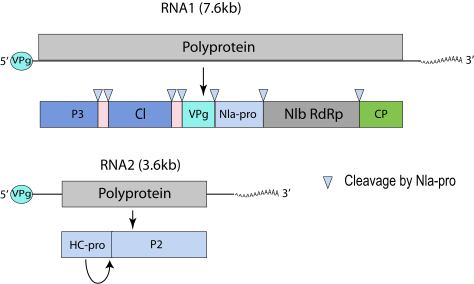
Bipartite, linear, ssRNA(+) genome, composed of RNA1=7.6-7.8 kb and RNA2=3.5-3.8 kb. 3' terminus has a poly (A) tract. 5' terminus has a genome-linked protein (VPg).
GENE EXPRESSION
The virion RNA is infectious and serves as both the genome and viral messenger RNA. The genome segments are translated into polyproteins which are subsequently processed by virus-encoded proteases into functional products.
ENZYMES
- RNA-dependent RNA polymerase [Nlb-RdRp]
- VPG-type capping [VPg]
- Self cleavage N-ter polyprotein (Peptidase C6) [HC-pro]
- Polyprotein protease (Peptidase C4) [Nla-pro]
REPLICATION
CYTOPLASMIC
- Virus penetrates into the host cell.
- Uncoating, and release of the viral genomic RNA into the cytoplasm.
- The viral RNA is translated to produce a polyprotein which is processed by viral proteases into the RdRp protein and structural proteins.
- Replication takes place in cytoplasmic viral factories. A dsRNA genome is synthesized from the genomic ssRNA(+).
- The dsRNA genome is transcribed/replicated thereby providing viral mRNAs/new ssRNA(+) genomes.
- Virus assembly in the cytoplasm.
Matching UniProtKB/Swiss-Prot entries
(all links/actions below point to uniprot.org website)10 entries grouped by strain
2 entries
Barley yellow mosaic virus (isolate China/Yancheng/1998) (BaYMV) reference strain
1 entry
Barley mild mosaic virus (strain UK-F) (BaMMV) reference strain
2 entries
Barley mild mosaic virus (strain Na1) (BaMMV)
2 entries
Barley yellow mosaic virus (isolate Germany) (BaYMV)
2 entries
Barley yellow mosaic virus (strain Japanese II-1) (BaYMV)
1 entry
Barley mild mosaic virus (strain ASL) (BaMMV)
Rice necrosis mosaic virus taxid:59500
| Protein | ModelArchive |
| Genome polyprotein 2 | ma-jd-viral-65710 |