

Fijivirus (taxid:10988)
VIRION
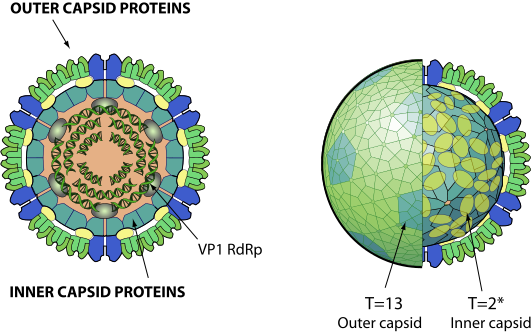
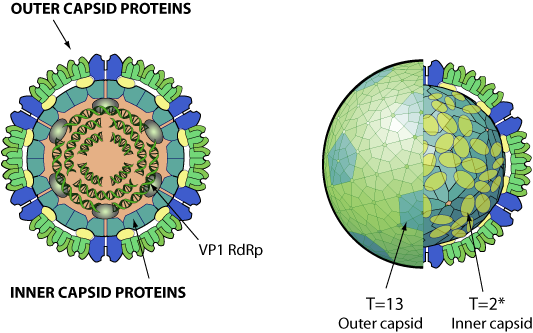
Non enveloped, icosahedral virion with a double capsid structure, about 65-70 nm in diameter. Pentameric turrets sit on the outside of the innermost capsid. The outer capsid has a T=13 icosahedral symmetry, the inner capsid a T=2* icosahedral symmetry.
GENOME
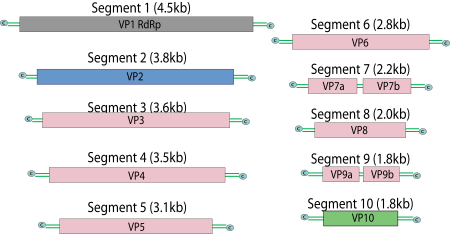
Segmented linear dsRNA genome. Contains 10 segments coding for 12 proteins. Segments size range from 1.4 to 4.5 kb. Genome total size is about 27-30 kb.
GENE EXPRESSION
The dsRNA genome is never completely uncoated, to prevent activation of antiviral state by the cell in response to dsRNA. The viral polymerase synthesizes a capped mRNA from each dsRNA segment. This capped mRNA is translocated to the cell cytoplasm where it is translated.
ENZYMES
- RNA-dependent RNA polymerase [VP1]
- Cell-type capping:
- RNA TPase
- N7 MTase
- GTase
- 2'O MTase
REPLICATION
CYTOPLASMIC
- Virus penetrates into the host cell.
- Particles are partially uncoated in endolysosomes, but not entirely, and penetrate in the cytoplasm.
- Early transcription of the dsRNA genome by viral polymerase occurs inside this sub-viral particle (naked core), so that dsRNA is never exposed to the cytoplasm.
- Full-length plus-strand transcripts from each of the dsRNA segments are synthesized. These plus-strand transcripts are used as templates for translation.
- Viral proteins and genomic RNAs aggregates in cytoplasmic viral factories.
- (+)RNAs are encapsidated in a sub-viral particle, in which they are transcribed to give RNA (-) molecules with which they become base-paired to produce dsRNA genomes.
- The capsid is assembled on the sub-viral particle.
- Mature virions are released presumably following cell death and associated breakdown of host plasma membrane.
Matching UniProtKB/Swiss-Prot entries
(all links/actions below point to uniprot.org website)15 entries grouped by strain
12 entries
Fiji disease virus (isolate Sugarcane) (FDV) reference strain
2 entries
Maize rough dwarf virus (MRDV)
1 entry
Rice black streaked dwarf virus (RBSDV)
Fiji disease virus (isolate Sugarcane) taxid:648172
| Protein | ModelArchive |
| Uncharacterized protein VP7-1 | ma-jd-viral-45689 |
| Uncharacterized protein VP7-2 | ma-jd-viral-29208 |
Mal de Rio Cuarto virus taxid:185954
Rice black streaked dwarf virus taxid:10990
Southern rice black-streaked dwarf virus taxid:519497
| Protein | ModelArchive |
| Nonstructural protein 9-1 | ma-jd-viral-48716 |
| Nonstructural protein 9-2 | ma-jd-viral-57544 |
| p10 protein | ma-jd-viral-34060 |