

Rubivirus (taxid:11040)
VIRION
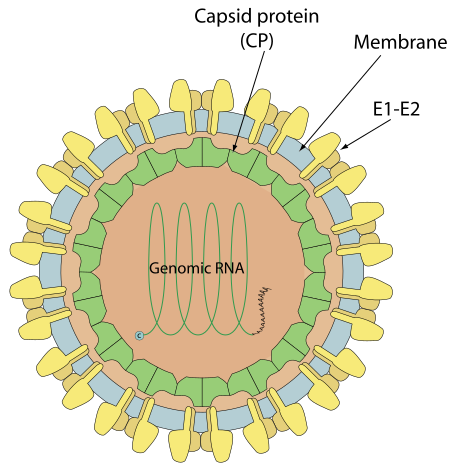
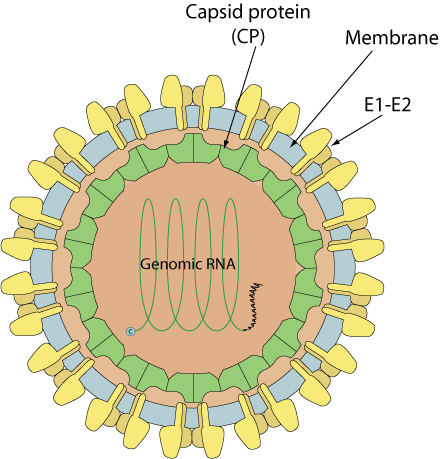
Enveloped, spherical, 70-80nm in diameter. The capsid is not icosahedric and bound to the membrane  . Envelope glycoproteins are assembled in helical organization .
GENOME
Vidya Mangala Prasad, Thomas Klose, Michael G. Rossmann
PLoS Pathog. June 2017; 13: e1006377
Vidya Mangala Prasad, Steven D. Willows, Andrei Fokine, Anthony J. Battisti, Siyang Sun, Pavel Plevka, Tom C. Hobman, Michael G. Rossmann
Proc. Natl. Acad. Sci. U.S.A. 10 December 2013; 110: 20105?20110
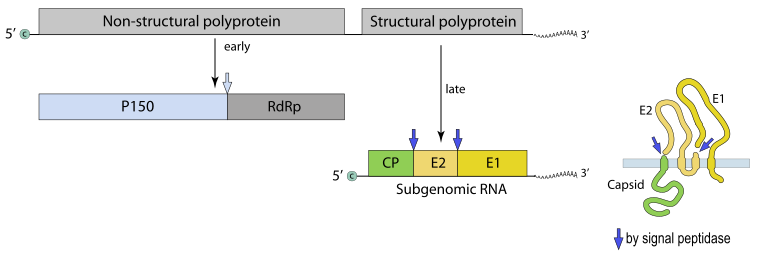
Monopartite, linear, ssRNA(+) genome of 9.7 kb. The genome is capped and polyadenylated.
GENE EXPRESSION
The virion RNA is infectious and serves as both genome and viral messenger RNA. The whole genome is translated in a non-structural polyprotein which is processed by host and viral proteases. Structural polyprotein is expressed through a subgenomic mRNA.
ENZYMES
- RNA-dependent RNA polymerase [P13889]
- Polyprotein protease (Peptidase C27) [P13889]
- Alpha-type capping [P13889]
- ADP-Ribosylhydrolase [P13889]
REPLICATION
CYTOPLASMIC
- Attachement of the viral E glycoprotein to host receptors mediates clathrin-mediated endocytosis of virus into the host cell.
- Fusion of virus membrane with host endosomal membrane. RNA genome is released into the cytoplasm.
- The positive-sense genomic ssRNA is translated into a polyprotein, which is cleaved into non-structural proteins necessary for RNA synthesis (replication and transcription).
- Replication takes place in cytoplasmic viral factories at the surface of endosomes. A dsRNA genome is synthesized from the genomic ssRNA(+).
- The dsRNA genome is transcribed/replicated thereby providing viral mRNAs/new ssRNA(+) genomes.
- Expression of the subgenomic RNA (sgRNA) gives rise to the structural proteins.
- Capsid assembly occurs at the Golgi membrane.
- The capsid is envelopped by budding at Golgi membrane where the virion exits the cell.
Host-virus interaction
Host gene expression shutoff by virus
Rubella virus capsid protein (Rubivirus) seems to mediate host translation shutoff by inhibiting host poly(A)-binding protein.
.
Matching UniProtKB/Swiss-Prot entries
(all links/actions below point to uniprot.org website)19 entries grouped by strain
2 entries
Rubella virus (strain Therien) (RUBV) reference strain
2 entries
Rubella virus (strain BRD1) (RUBV)
2 entries
Rubella virus (strain BRDII) (RUBV)
2 entries
Rubella virus (strain Cendehill) (RUBV)
2 entries
Rubella virus (strain M33) (RUBV)
2 entries
Rubella virus (strain RA27/3 vaccine) (RUBV)
2 entries
Rubella virus (strain RN-UK86) (RUBV)
2 entries
Rubella virus (strain TO-336 vaccine) (RUBV)
2 entries
Rubella virus (strain TO-336) (RUBV)
1 entry