

Aphthovirus (taxid:12109)
VIRION
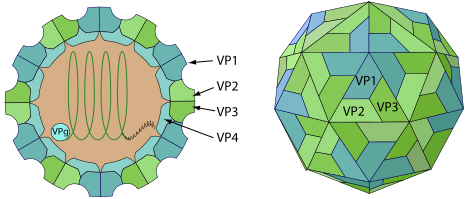
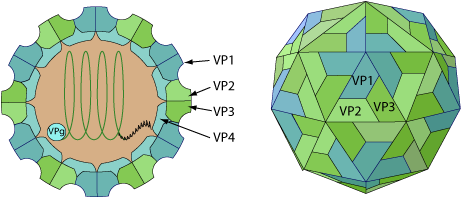
Non-enveloped, spherical, about 30 nm in diameter, pseudo T=3 icosahedral capsid surrounding the naked RNA genome. The capsid consists of a densely-packed icosahedral arrangement of 60 protomers, each consisting of 4 polypeptides, VP1, VP2, VP3 and VP4. VP4 is located on the internal side of the capsid.

GENOME
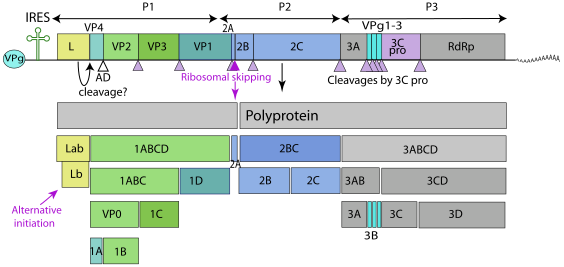
Linear ssRNA(+) genome of 7.5-8.5 kb, polyadenylated, composed of a single ORF encoding a polyprotein. Viral genomic RNA has a viral protein (VPg) at its 5'. The long UTR at the 5' end contains an internal ribosome entry site (IRES) type II. The P1 region encodes the structural polypeptides. The P2 and P3 regions encode the nonstructural proteins associated with replication. Encodes a N-terminal leader protease (L protease) in addition to the 3C protease. The shorter 3' UTR is important in (-)strand synthesis.
GENE EXPRESSION
The virion RNA is infectious and serves as both the genome and viral messenger RNA. The IRES allows direct translation of the polyprotein. The polyprotein is initially processed by the viral proteases into various precursor and mature proteins to yield the structural proteins, replicase, VPg, and a number of proteins that modify the host cell, ultimately leading to cell lysis.
Ribosomal skipping is used at the junction of the 2A and downstream sequence.
ENZYMES
- RNA-dependent RNA polymerase [RdRp]
- VPG-type capping [VPg]
- NTPase-helicase [2C]
- Polyprotein major protease (Peptidase C3) [3Cpro]
- Self cleaving protease (Peptidase C28) [L]
REPLICATION
CYTOPLASMIC
- Attachement of the virus to host receptors mediates endocytosis of the virus into the host cell by clathrin-dependent endocytosis.
- Upon endosomal acidification, the capsid releases VP4 that opens a pore in the host endosomal membrane and the viral genomic RNA penetrates into the host cell cytoplasm. Acidic PH dissociates the capsid into pentameric subunits.
- VPg is removed from the viral RNA, which is then translated into a processed polyprotein.
- Shutoff of cellular cap-dependent translation through the cleavage of translation initiation factors by viral protease.
- Replication occurs in viral factories made of membrane vesicles derived from the ER. A dsRNA genome is synthesized from the genomic ssRNA(+).
- The dsRNA genome is transcribed/replicated thereby providing viral mRNAs/new ssRNA(+) genomes.
- New genomic RNA is believed to be packaged into preassembled procapsids.
- Cell lysis and virus release.
- Maturation of provirions by an unknown host protease.
Host-virus interaction
Apoptosis modulation
Picornaviruses modulate host apoptosis  .
.
Modulation of apoptosis depends on the host cell-type and on the time the infection because of the presence of viral pro- and anti-apoptotic factors respectively at the beginning and at the end of the infectious cycle
.
Autophagy modulation
Foot-and-mouth disease virus subvert the cell autophagic pathway
Innate immune response inhibition
Foot-and-mouth disease virus leader protein inhibits the host IFN-mediated response by inhibiting IRF-3
.
Host gene expression shutoff by virus
FMDV inhibits host translation by cleaving eIF3a, eIF3b, and PABP
.
Matching UniProtKB/Swiss-Prot entries
(all links/actions below point to uniprot.org website)12 entries grouped by strain
1 entry
Foot-and-mouth disease virus (isolate -/Germany/C1Oberbayen/1960 serotype C) (FMDV) reference strain
1 entry
Foot-and-mouth disease virus (isolate Bovine/United Kingdom/A12Valle119/1932 serotype A) (FMDV) reference strain
1 entry
Foot-and-mouth disease virus serotype O (FMDV) reference strain
1 entry
Foot-and-mouth disease virus (isolate -/Azerbaijan/A22-550/1965 serotype A) (FMDV)
1 entry
Foot-and-mouth disease virus (isolate -/Brazil/C3Indaial/1971 serotype C) (FMDV)
1 entry
Foot-and-mouth disease virus (isolate -/Germany/A5Westerwald/1951 serotype A) (FMDV)
1 entry
Foot-and-mouth disease virus (isolate -/Spain/S8c1SantaPau/1970 serotype C) (FMDV)
1 entry
Foot-and-mouth disease virus (isolate Bovine/Brazil/A24Cruzeiro/1955 serotype A) (FMDV)
1 entry
Foot-and-mouth disease virus (isolate Swine/Taiwan/OTai/1997 serotype O) (FMDV)
1 entry
Foot-and-mouth disease virus (strain A10/Holland/1961 serotype A) (FMDV)
1 entry
Foot-and-mouth disease virus serotype Asia-1 (FMDV)
1 entry