

Dependoparvovirus (taxid:10803)
Satellite virus: infectious only if host cell is co-infected with Adenovirus or Herpesvirus
VIRION
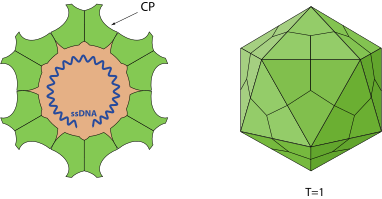
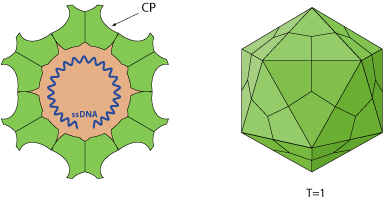
Non-enveloped, round, T=1 icosahedral symmetry, 18-26 nm in diameter. The capsid consists of 60 copies of CP protein.

GENOME
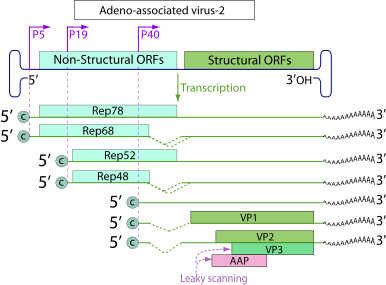
Linear, ssDNA genome of about 4.7kb in size. Equal amount of positive and negative strands are encapsidated, although the percentage of particles encapsidating the positive strand can be lower depending on the host cell. ORFs for both the structural and non-structural proteins are located on the same DNA strand.
The genome is replicated through rolling-hairpin mechanism. All dependoviruses except duck parvovirus and goose parvovirus depend on helper adenovirus or herpesvirus to replicate efficiently.
GENE EXPRESSION
Host proteins transcribe the genomes into mRNAs. Transcription is regulated by the three promoters P5, P19 and P40: P5 transcripts are expressed first, followed by those from P19, then those from P40. Alternative splicing allows expression of three different mRNAs for each promoter. mRNA9 is translated into VP2, or VP3 by leaky scanning.
ENZYMES
REPLICATION
NUCLEAR
- Attachement to host receptors initiates clathrin-mediated endocytosis of the virion into the host cell.
- The virion penetrates into the cytoplasm via permeabilization of host endosomal membrane.
- Microtubular transport of the virion toward the nucleus.
- The viral ssDNA genome penetrates into the nucleus.
- The ssDNA is converted into dsDNA by cellular proteins. Occasionally, the viral genome can be integrated in host chromosome
- dsDNA transcription gives rise to viral mRNAs when host cell enters S phase and translated to produce viral proteins.
- Replication occurs through rolling-hairpin mechanism.
- These newly synthesized ssDNA can either
a) be converted to dsDNA and serve as a template for transcription/replication
b) be encapsidated to form new virions that are released by cell lysis.
Host-virus interaction
Apoptosis modulation
AAV induces apoptosis
and caspases activation in p53-deficient cells
 .
.
When coinfecting with adenovirus, AAV induces apoptosis by activating the DNA damage response. This is probably linked to the presence of a specific sequence in the viral genome.
.
Cell-cycle modulation
AAV induces G2/M checkpoint arrest
.
Matching UniProtKB/Swiss-Prot entries
(all links/actions below point to uniprot.org website)6 entries grouped by protein
1 entry
Assembly activating protein AAP
1 entry
Capsid protein VP1
1 entry
Protein Rep40 (EC 3.6.4.12)
1 entry
Protein Rep52
1 entry
Protein Rep68 (EC 3.6.4.12)
1 entry
Protein Rep78
Adeno-associated virus 2 taxid:10804
| Protein | ModelArchive |
| X protein | ma-jd-viral-50472 |
Adeno-associated virus 2 (isolate Srivastava/1982) taxid:648242
Adeno-associated virus 8 taxid:202813
| Protein | ModelArchive |
| Capsid protein | ma-jd-viral-07306 |
| Nonstructural protein | ma-jd-viral-23504 |
Bat adeno-associated virus YNM taxid:727962
| Protein | ModelArchive |
| Cap protein | ma-jd-viral-07334 |
| Rep protein | ma-jd-viral-23494 |
Bearded dragon parvovirus taxid:1670662
| Protein | ModelArchive |
| Assembly activating protein | ma-jd-viral-47455 |
| Capsid protein | ma-jd-viral-41350 |
| Nonstructural protein | ma-jd-viral-23472 |
Goose parvovirus taxid:38251
| Protein | ModelArchive |
| REP | ma-jd-viral-23502 |
| VP1 | ma-jd-viral-07314 |
| VP2 | ma-jd-viral-07276 |
| VP3 | ma-jd-viral-07320 |
Muscovy duck parvovirus taxid:37325
| Protein | ModelArchive |
| Capsid protein VP | ma-jd-viral-07281 |
| Capsid protein VP | ma-jd-viral-07331 |
| Capsid protein VP | ma-jd-viral-07338 |
| REP protein | ma-jd-viral-23491 |
adeno-associated virus 7 taxid:202812
| Protein | ModelArchive |
| Capsid protein | ma-jd-viral-07348 |
| Nonstructural protein | ma-jd-viral-23487 |