

Fabavirus (taxid:12269)
VIRION
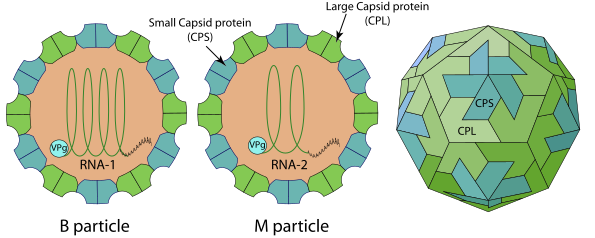
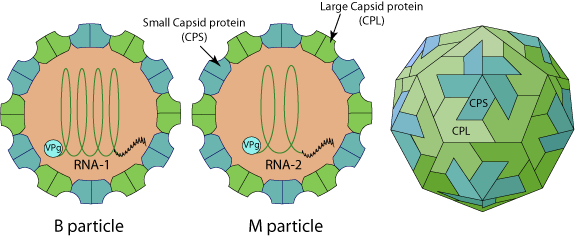
Non-enveloped, 28-30 nm in diameter, pseudo T=3 icosahedral capsid. The capsid is composed of 60 CPS (whih one jelly rolls domain) and 60 CPL proteins (with two jell rolls domains). Genomic RNAs are encapsidated separately into two different types of particle of similar size.
GENOME
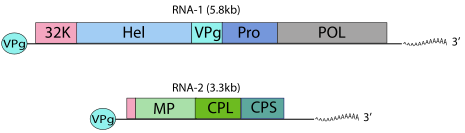
Segmented, bipartite linear ssRNA(+) genome composed of RNA-1=5.8 kb and RNA-2=3.4 kb. Each genomic segment has a VPg linked to its 5' end and a 3' poly(A) tract.
GENE EXPRESSION
The virion RNA is infectious and serves as both the genome and mRNA.
RNA-1 and RNA-2 are translated into two polyproteins, which are then processed into functional proteins. RNA1 encodes proteins necessary for replication, while RNA-2 encodes two capsid proteins and product(s) involved in cell-to-cell movement.
ENZYMES
- RNA-dependent RNA polymerase [RdRp]
- VPG-type capping [VPg]
- NTPase-helicase [Hel]
- Polyprotein major protease (Peptidase C3) [Pro]
REPLICATION
CYTOPLASMIC
- Virus penetrates into the cell.
- Uncoating, and release of the viral genomic RNA into the cytoplasm.
- Synthesis and proteolytic cleavage of the replicase polyprotein RNA-1.
- Replication occurs in viral factories made of membrane vesicles derived from the ER. A dsRNA genome is synthesized from the genomic ssRNA(+).
- The dsRNA genome is transcribed/replicated thereby providing viral mRNAs/new ssRNA(+) genomes.
- Assembly of new virus particles.
- Movement protein allows cell-to-cell movement.
Matching UniProtKB/Swiss-Prot entries
(all links/actions below point to uniprot.org website)4 entries grouped by protein
2 entries
RNA1 polyprotein (Genome polyprotein B)
2 entries