

Mycoreovirus (taxid:311227)
VIRION
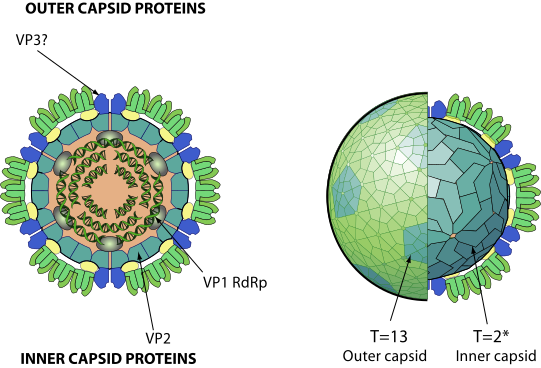
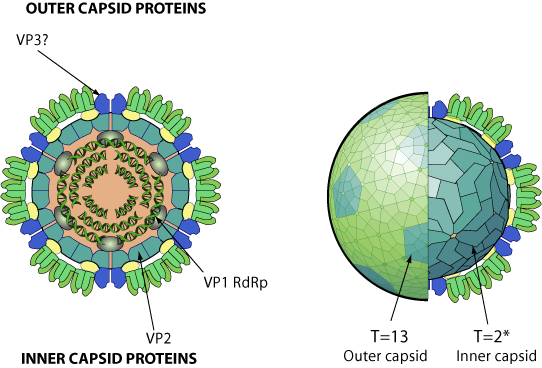
Non enveloped, icosahedral virion with a double capsid structure, about 80 nm in diameter. The outer capsid has a T=13 icosahedral symmetry, the inner capsid a T=2* icosahedral symmetry.
GENOME
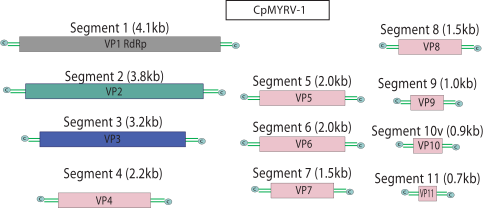
Segmented linear dsRNA genome. Contains 11 or 12 segments coding respectively for 11 or 12 proteins (each segment contains a single ORF). Segments size range from 0.7 to 4.1 kb, genome total size is about 23 kb (CpMYRV-1).
GENE EXPRESSION
The dsRNA genome is never completely uncoated, to prevent activation of antiviral state by the cell in response to dsRNA. The viral polymerase synthesizes a capped mRNA from each dsRNA segment. This capped mRNA is translocated to the cell cytoplasm where it is translated.
ENZYMES
REPLICATION
CYTOPLASMIC
- Attachment to host receptors probably mediates endocytosis of virus into host cell.
- Particles are partially uncoated in endolysosomes, but not entirely, and penetrate in the cytoplasm.
- Early transcription of the dsRNA genome by viral polymerase occurs inside this sub-viral particle (naked core), so that dsRNA is never exposed to the cytoplasm.
- Full-length plus-strand transcripts from each of the dsRNA segments are synthesized. These plus-strand transcripts are used as templates for translation.
- Viral proteins and genomic RNAs aggregates in cytoplasmic viral factories.
- (+)RNAs are encapsidated in a sub-viral particle, in which they are transcribed to give RNA (-) molecules with which they become base-paired to produce dsRNA genomes.
- The capsid is assembled on the sub-viral particle.
- Mature virions are released presumably following cell death and associated breakdown of host plasma membrane. They can be transmitted to new cell by cytoplasmic exchange, sporogenesis or hyphal anastomosis.
Matching UniProtKB/Swiss-Prot entries
(all links/actions below point to uniprot.org website)11 entries grouped by protein
1 entry
Inner capsid protein VP2
1 entry
RNA-directed RNA polymerase VP1 (EC 2.7.7.48)
1 entry
Uncharacterized protein VP10
1 entry
Uncharacterized protein VP11
1 entry
Outer capsid protein VP3
1 entry
Uncharacterized protein VP4
1 entry
Uncharacterized protein VP5
1 entry
Microtubule-associated protein VP6
1 entry
Uncharacterized protein VP7
1 entry
Uncharacterized protein VP8
1 entry