

Gyrovirus (taxid:227307)
VIRION
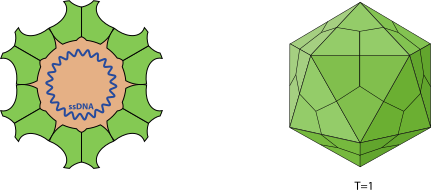
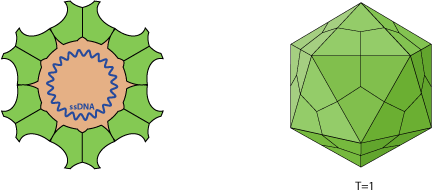
Non-enveloped, round, T=1 icosahedral symmetry, about 25 nm in diameter. The capsid consists of 12 pentagonal trumpet-shaped pentamers.

GENOME
Monopartite, circular, ssDNA genome of about 2300 bp.
The genome is replicated through double-stranded intermediates. A replication Rep-like protein would initiates rolling circle replication.
GENE EXPRESSION
One mRNA is transcribed by cellular RNA polymerase II and encodes for three proteins: VP1, VP2 and VP3 probably through leaky scanning mechanism.
REPLICATION
NUCLEAR
- Virus penetrates into the host cell.
- Uncoating, the viral ssDNA genome penetrates into the nucleus.
- Viral ssDNA is converted into dsDNA with the participation of cellular factors. dsDNA transcription gives rise to viral mRNAs.
- Viral mRNAs are translated to produce viral proteins.
- Replication may be mediated by a Rep protein, and would occur by rolling circle replication producing ssDNA genomes.
- These newly synthesized ssDNA can either
a) be converted to dsDNA and serve as a template for transcription/replication
b) be encapsidated by capsid protein and form virions released by cell lysis.
Host-virus interaction
Apoptosis modulation
Chicken anemia virus VP3 protein induces apoptosis observed in CAV infection. Virus-induced apoptosis accounts for the severe depletion of cortical thymocytes and erythroblastoid cells in the bone marrow
 .
.
Matching UniProtKB/Swiss-Prot entries
(all links/actions below point to uniprot.org website)16 entries grouped by strain
3 entries
Chicken anemia virus (isolate Germany Cuxhaven-1) (CAV) reference strain
3 entries
Chicken anemia virus (isolate Australia/CAU269-7/2000) (CAV)
3 entries
Chicken anemia virus (isolate Japan 82-2) (CAV)
3 entries
Chicken anemia virus (isolate USA 26p4) (CAV)
3 entries
Chicken anemia virus (isolate USA CIA-1) (CAV)
1 entry
Chicken anemia virus (isolate Australia) (CAV)
Avian gyrovirus 2 taxid:1002273
| Protein | ModelArchive |
| Apoptin | ma-jd-viral-47567 |
| Capsid protein (CA1) (Coat protein) | ma-jd-viral-36700 |
| Dual specificity protein phosphatase VP2 (EC 3.1.3.16) (EC 3.1.3.48) | ma-jd-viral-59473 |
Gyrovirus 4 taxid:1214955
| Protein | ModelArchive |
| Capsid protein (CA1) (Coat protein) | ma-jd-viral-36699 |
| Dual specificity protein phosphatase VP2 (EC 3.1.3.16) (EC 3.1.3.48) | ma-jd-viral-38362 |
Gyrovirus GyV3 taxid:1163715
| Protein | ModelArchive |
| Apoptin | ma-jd-viral-47568 |
| Capsid protein (CA1) (Coat protein) | ma-jd-viral-36701 |
| Dual specificity protein phosphatase VP2 (EC 3.1.3.16) (EC 3.1.3.48) | ma-jd-viral-59471 |
Gyrovirus GyV8 taxid:1670973
| Protein | ModelArchive |
| Capsid protein (CA1) (Coat protein) | ma-jd-viral-36698 |
| Uncharacterized protein | ma-jd-viral-54954 |
| VP2 | ma-jd-viral-32010 |
Gyrovirus Tu243 taxid:1415627
Gyrovirus Tu789 taxid:1415628
| Protein | ModelArchive |
| Apoptin | ma-jd-viral-47566 |
| Capsid protein (CA1) (Coat protein) | ma-jd-viral-36697 |
| Dual specificity protein phosphatase VP2 (EC 3.1.3.16) (EC 3.1.3.48) | ma-jd-viral-59472 |