

Alphatetraviridae (taxid:1283207)
VIRION
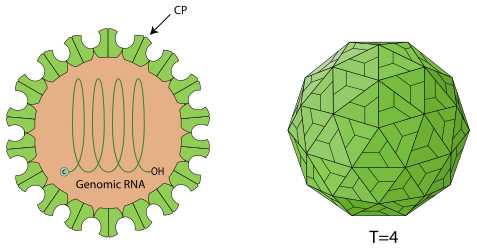
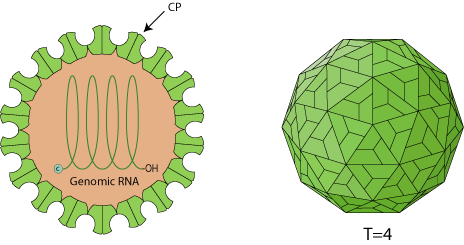
Non enveloped virion, about 40 nm in diameter with a T=4 icosahedral symmetry (240 copies of two proteins derived from the capsid precursor cleavage).

GENOME
Monopartite (Betatetravirus) or bipartite (Omegatetravirus) linear ssRNA(+) genome of about 6.5 kb. The 5' terminus is capped in Omegatetraviruses but not in Betatetraviruses. The 3' terminus is not polyadenylated but terminates with a distinctive tRNA-like structure.
GENE EXPRESSION
The virion RNA is infectious and serves as both the genome and viral messenger RNA. Genomic RNA is translated into a polyprotein which is cleaved presumably by a viral protease into replication proteins. Replication produces a subgenomic RNA which encodes for capsid protein.
ENZYMES
- RNA-dependent RNA polymerase [RNA polymerase]
- Alpha type capping
- RNA TPase ?
- N7 MTase [RNA polymerase]
- GTase ?
- 2'O MTase ?
- Asparagine proteases (Peptidase N2) [Capsid]
REPLICATION
CYTOPLASMIC
- Virus penetrates into the host cell.
- Uncoating, and release of the viral genomic RNA into the cytoplasm.
- Genomic RNA is translated to produce replication proteins.
- Replication takes place in cytoplasmic viral factories. A dsRNA genome is synthesized from the genomic ssRNA(+).
- The dsRNA genome is transcribed/replicated thereby providing viral mRNAs/new ssRNA(+) genomes.
- Expression of the subgenomic RNA encoding the capsid protein.
- Assembly of new virus particles.
Matching UniProtKB/Swiss-Prot entries
(all links/actions below point to uniprot.org website)5 entries grouped by strain
3 entries
Helicoverpa armigera stunt virus (HaSV) reference strain
2 entries