

Crinivirus (taxid:67753)
VIRION
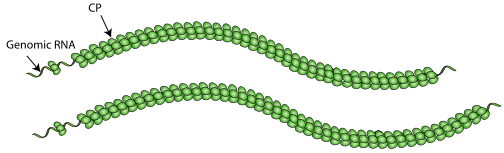
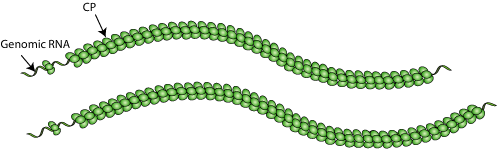
Non-enveloped, bipartite filamentous particles about 650-850 nm and 700-900 nm in length, and 10-13 nm in diameter. The virion body is assembled by the major capsid protein (CP) and the tail by the minor capsid protein (CPm).
GENOME
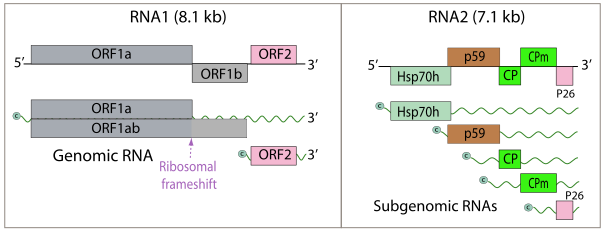
Bipartite linear ssRNA(+) genome of 15.3 to 17.6 kb. 3' terminus has no poly(A) tract and the 5' terminus probably has a methylated nucleotide cap.
GENE EXPRESSION
The virion RNA is infectious and serves as both the genome and viral messenger RNA. ORF1a and ORF1ab protein (containing RdRp) are produced by ribosomal frameshifting. Other ORFs are translated from a set of nested 3' co-terminal subgenomic RNAs.
ENZYMES
REPLICATION
CYTOPLASMIC
- Virus penetrates into the host cell.
- Uncoating, and release of the viral genomic RNA into the cytoplasm.
- The viral RNA is translated into a processed ORF1 polyprotein to yield the replication proteins.
- Replication occurs in viral factories. A dsRNA genome is synthesized from the genomic ssRNA(+).
- The dsRNA genome is transcribed/replicated thereby providing viral mRNAs/new ssRNA(+) genomes.
- Subgenomic RNA translation gives rise to the other viral proteins.
- Assembly of new virus particles.
- Viral movement proteins mediate virion cell-to-cell transfer.
Host-virus interaction
Suppression of RNA silencing
Sweet potato chlorotic stunt virus and Tomato chlorosis virus p22 proteins
also function as suppressors of RNA silencing

Matching UniProtKB/Swiss-Prot entries
(all links/actions below point to uniprot.org website)9 entries grouped by strain
9 entries