

Unresolvable Taxon:119163 (taxid:119163)
Former family that do not exist anymore
VIRION
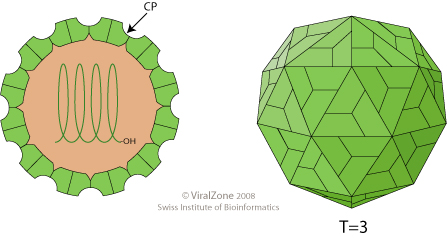
Non-enveloped, spherical virion about 25-30 nm in diameter with T=3 icosahedral symmetry composed of 180 CP proteins.
GENOME
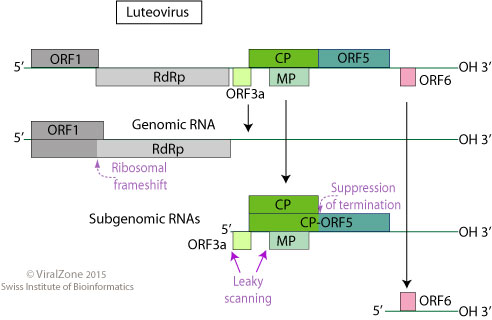
Monopartite, linear, ssRNA(+) genome of 5.3-5.7 kb. Poleroviruses and enamoviruses have a VPg bound at the 5' end. There is no poly(A) tail or tRNA-like structure at the 3' end.
GENE EXPRESSION
The virion RNA is infectious and serves as both the genome and viral messenger RNA. The viral polymerase is expressed by a ribosomal frameshifting at the end of ORF1.
Depending on the genus, several proteins can be produced by Leaky scanning. Suppression of termination of the CP stop codon produces CP-RTD (CP extended), the capsid subunit essential for aphid transmission.
REPLICATION
CYTOPLASMIC
- Virus penetrates into the host cell.
- Uncoating, and release of the viral genomic RNA into the cytoplasm.
- The viral RNA ORF1 and ORF2 are translated to produce the RdRp fusion protein.
- Replication takes place in cytoplasmic viral factories. A dsRNA genome is synthesized from the genomic ssRNA(+).
- The dsRNA genome is transcribed/replicated thereby providing viral mRNAs/new ssRNA(+) genomes.
- Expression of the 3' coterminal sgRNAs. Traduction of these sgRNAs yields the capsid, CP-RTD and movement proteins.
- Virus assembly.
- Viral movement protein probably mediates virion cell-to-cell transfer.
Host-virus interaction
Suppression of RNA silencing
Polerovirus protein P0 acts as a suppressor of RNA silencing by targeting Argonaute 1 for degradation
 .
.
Enamovirus protein P0 acts as a suppressor of RNA silencing by targeting Argonaute 1 for degradation
Barley yellow dwarf virus protein P6 acts as a suppressor of RNA silencing