

Viral genome excision (kw:KW-1250)
Most temperate phages encode an integrase for both integration and excision. Excision may require an accessory protein called excisionase or recombination directionality factor to promote excision  Excision is the recombination event that leads to the release of a viral genome that was formerly integrated into the host DNA chromosome as a provirus. This release is usually induced upon changes in the host cell physiology (induction).
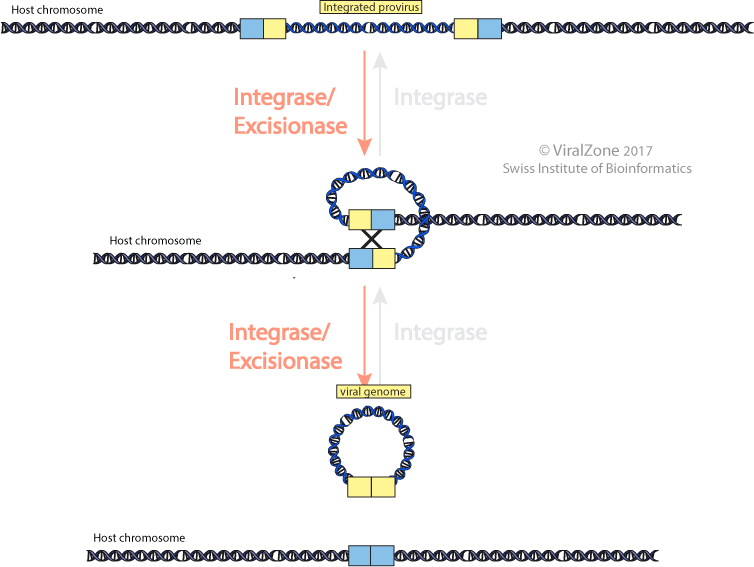
NB. Aberrant excision may occur. Small pieces of bacterial DNA may become excised and packaged into the bacteriophage capsid together with the bacteriophage genome. This exchange of genetic information is called transduction .
Pallavi Ghosh, Lori A Bibb, Graham F Hatfull
Proc. Natl. Acad. Sci. U.S.A. March 4, 2008; 105: 3238-3243
D Y Kwoh, J Kemper
J. Virol. September 1978; 27: 519-534
My D Sam, Duilio Cascio, Reid C Johnson, Robert T Clubb
J. Mol. Biol. April 23, 2004; 338: 229-240
Ronnie P-A Berntsson, Richard Odegrip, Wilhelmina Sehlen, Karin Skaar, Linda M Svensson, Tariq Massad, Martin Hogbom, Elisabeth Haggard-Ljungquist, Pal Stenmark
Nucleic Acids Res. November 19, 2013;
Aras N. Mattis, Richard I. Gumport, Jeffrey F. Gardner
J Bacteriol September 2008; 190: 5781-5796
Alfonso P Farruggio, Christopher L Chavez, Carlos L Mikell, Michele P Calos
Biotechnol J November 2012; 7: 1332-1336
J. A. Lewis, G. F. Hatfull
Mol. Microbiol. January 2000; 35: 350-360
J. M. Leong, S. E. Nunes-D?by, A. B. Oser, C. F. Lesser, P. Youderian, M. M. Susskind, A. Landy
J. Mol. Biol. June 20, 1986; 189: 603-616
Matching UniProtKB/Swiss-Prot entries
(all links/actions below point to uniprot.org website)0 entry grouped by strain