

Nucleotide antiviral signaling
Viral Evasion of STING-Mediated DNA Sensing and Stress Responses
 It is activated by the aberrant presence of DNA in the cytoplasm. While primarily involved in defense against DNA viruses, this pathway can also be triggered during RNA virus infections, which may induce the release of mitochondrial DNA into the host cytosol. .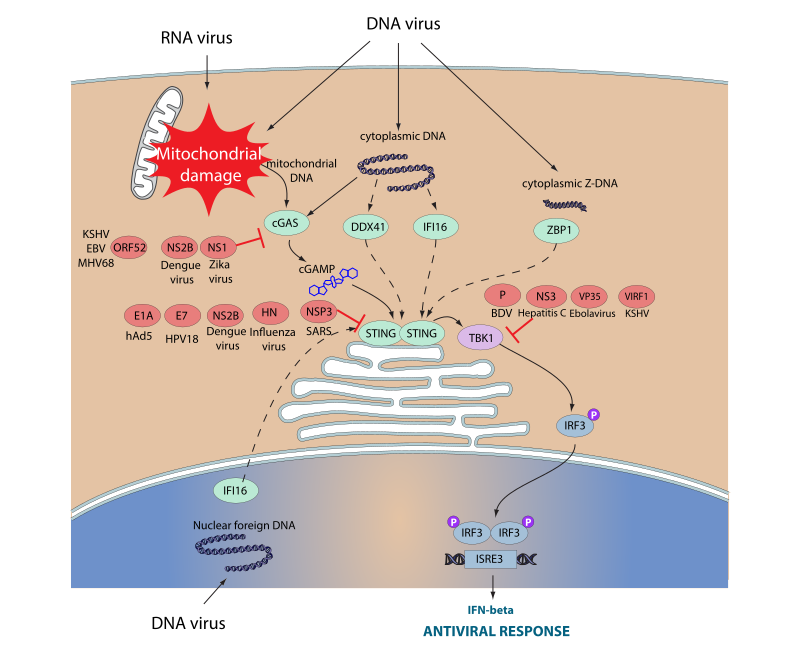
Several cytosolic DNA sensors activate the interferon response through STING, including ZBP1 , DDX41 , IFI16 and cGAS .
The major pathway is mediated by cGAS-STING. cGAS detects aberrant cytoplasmic DNA and synthesizes cyclic GMP-AMP (cGAMP), which binds and activates STING. Activated STING dimerizes and oligomerizes, leading to the induction of two signaling branches: (i) type I interferon production via TBK1 and IRF3, and (ii) inflammatory responses via NF-?B activation.
IFI16 plays an essential antiviral role in nuclear viral DNA sensing. Herpesvirales do not expose their DNA in the cytoplasm, but still they induce IRF3-mediated antiviral response and this happens through IFI16.The way IFI16 distinguishes self nuclear DNA and foreign is under investigation, but the signaling seems to rely on IFI16 assembled in filaments on viral dsDNA.
Sato H., Hoshi M., Ikeda F., Fujiyuki T., Yoneda M.
PLoS Pathog. 2021 Oct 14;17(10)
Akinori Takaoka, Zhichao Wang, Myoung Kwon Choi, Hideyuki Yanai, Hideo Negishi, Tatsuma Ban, Yan Lu, Makoto Miyagishi, Tatsuhiko Kodama, Kenya Honda, Yusuke Ohba, Tadatsugu Taniguchi
Nature July 26, 2007; 448: 501?505
Leonie Unterholzner
Immunobiology July 29, 2013;
Leonie Unterholzner, Sinead E Keating, Marcin Baran, Kristy A Horan, S?ren B Jensen, Shruti Sharma, Cherilyn M Sirois, Tengchuan Jin, Eicke Latz, T Sam Xiao, Katherine A Fitzgerald, S?ren R Paludan, Andrew G Bowie
Nat. Immunol. November 2010; 11: 997?1004
Zhiqiang Zhang, Bin Yuan, Musheng Bao, Ning Lu, Taeil Kim, Yong-Jun Liu
Nat. Immunol. October 2011; 12: 959?965
Lijun Sun, Jiaxi Wu, Fenghe Du, Xiang Chen, Zhijian J Chen
Science February 15, 2013; 339: 786?791
Megan H Orzalli, Neal A DeLuca, David M Knipe
Proc. Natl. Acad. Sci. U.S.A. October 30, 2012; 109: E3008?3017
Seamus R Morrone, Tao Wang, Leeza M Constantoulakis, Richard M Hooy, Michael J Delannoy, Jungsan Sohn
Proc. Natl. Acad. Sci. U.S.A. January 7, 2014; 111: E62?71