


Poxvirus replication cycle
- Virus entry:
- Extracellular virions can enter by macropinocytosis
 or by direct entry at the cell surface. Host receptors are unknown. Macropinocytosis can involve apoptotic mimicry
- Extracellular virions can enter by macropinocytosis
- Transcription in cytoplasmic factories
- early: Viral replication machinery, host-modulating factors, core-associated enzymes and extracellular virion
membrane proteins (about 118 genes in vaccinia virus)
- Postreplicative events:
- Intermediate:DNA binding/packaging and core-associated nonenzymatic
proteins (53 Genes in vaccinia virus)
- late: redox disulfide bond enzymes, virion
morphogenesis, crescent formation proteins, mature
virion membrane proteins and components of the entry-fusion complex (38 genes in vaccinia virus)
- Intermediate:DNA binding/packaging and core-associated nonenzymatic
proteins (53 Genes in vaccinia virus
- early: Viral replication machinery, host-modulating factors, core-associated enzymes and extracellular virion
membrane proteins (about 118 genes in vaccinia virus
- Virion assembly
- virus exit
- by budding of Enveloped virion (EV), supported by Actin-dependent outward viral transport
- by cell lysis, releasing mature virions (MV).
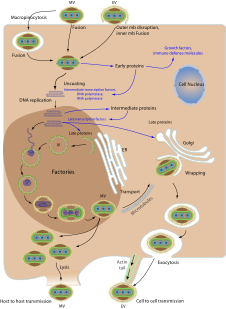
Important: Poxvirus genes are transcribed in the cytoplasm by viral enzymes and are not spliced because there are no splicing machinery outside the nucleus. If they were expressed from a plasmid in the nucleus, artefacts could result from mRNA splicing. The surface proteins of mature virions are not expressed in the endoplasmic reticulum of the cell, and the disulfide bonds are made by a viral sulfohydryl-oxidase in the cytoplasm. Expression of these proteins from plasmids can lead to artefacts. Acknowledgement: Thanks for the help of Rich Condit, Nissin Moussatche and Bernard Moss.
Apoptotic mimicry: phosphatidylserine-mediated macropinocytosis of vaccinia virus
Jason Mercer, Ari Helenius
Ann. N. Y. Acad. Sci. October 2010; 1209: 49?55
Vaccinia virus uses macropinocytosis and apoptotic mimicry to enter host cells
Jason Mercer, Ari Helenius
Science. 2008 Apr 25;320(5875):531-5
In a nutshell: structure and assembly of the vaccinia virion
Richard C Condit, Nissin Moussatche, Paula Traktman
Adv Virus Res. 2006;66:31-124.
Expression Profiling of the Intermediate and Late Stages of Poxvirus Replication
Zhilong Yang, Sara E. Reynolds, Craig A. Martens, Daniel P. Bruno, Stephen F. Porcella, and Bernard Moss
J Virol. 2011 Oct; 85(19): 9899?9908